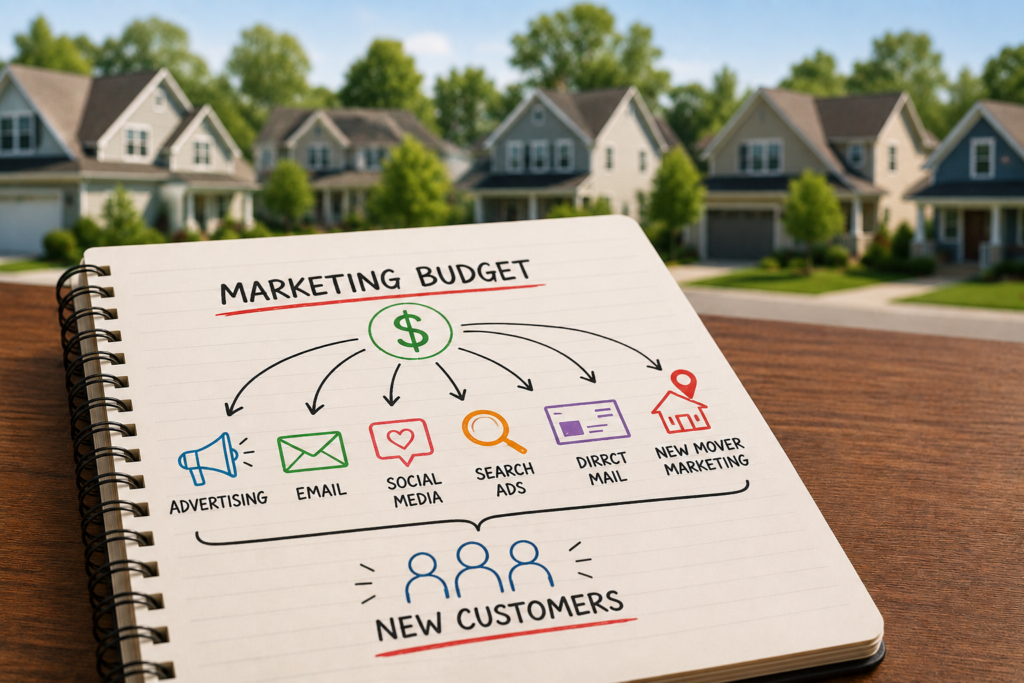
“How much should I spend on marketing?”
It sounds like a simple question. But for most local businesses, there isn’t one percentage or dollar amount that works for everyone.
A restaurant trying to increase weekly traffic has different goals than a growing dental practice. A new HVAC company needs to build awareness differently than an established auto repair shop with thousands of customers.
The better question is:
What does your business need to spend to acquire enough customers to reach its growth goals?
Once you start looking at your marketing budget that way, the conversation changes.
Don’t Start With a Percentage. Start With a Goal.
Marketing budgets are often discussed as a percentage of annual revenue.
That can be a helpful benchmark, but it shouldn’t be the entire strategy.
Instead, start with what you’re trying to accomplish.
Do you want to:
- Increase new customer acquisition?
- Open or grow a new location?
- Increase traffic during slower months?
- Introduce your business to a new market?
- Generate more repeat business?
- Prevent competitors from gaining market share?
A business focused primarily on maintaining its current customer base may budget differently than one aggressively trying to grow.
Your marketing investment should reflect where you want the business to go—not simply where it is today.
Know What a New Customer Is Worth
One of the most useful numbers in your marketing budget isn’t your total marketing spend.
It’s your customer lifetime value.
Imagine a household tries your pizza restaurant for the first time and spends $30.
If you only look at that transaction, spending $15 or $20 to acquire the customer might seem expensive.
But what happens if they order twice a month?
That’s approximately $720 in annual revenue from a customer who originally walked through the door because of one marketing offer.
And if they remain a customer for several years, the value of that initial acquisition grows significantly.
The same principle applies to dentists, auto repair shops, salons, grocery stores, home service companies and many other local businesses.
Don’t evaluate customer acquisition based only on the first transaction.
Look at what a good customer could be worth over time.
Divide Your Budget Between Retention and Acquisition
Many businesses naturally spend more time marketing to existing customers.
And for good reason—existing customers already know you.
But every business experiences customer turnover.
People move. Needs change. Competitors enter the market. Customers simply stop coming.
That’s why part of your marketing budget should consistently focus on bringing new customers into the business.
A healthy strategy typically includes both:
Customer retention keeps existing customers engaged and encourages repeat purchases.
Customer acquisition introduces your business to people who haven’t chosen you yet.
You need both to create sustainable growth.
Don’t Forget About People Who Just Entered Your Market
There’s another audience local businesses frequently overlook when allocating their marketing budgets:
new movers.
Every month, new households enter your service area.
And unlike established residents, many haven’t already chosen their preferred local businesses.
They may need a new:
- Pizza place
- Grocery store
- Dentist
- Salon
- Gym
- Veterinarian
- Auto repair shop
- HVAC company
- Plumber
- Landscaper
- Hardware store
That makes new movers an especially interesting customer-acquisition audience.
Instead of spending your entire budget trying to persuade established residents to switch from businesses they already use, part of your budget can focus on consumers who are actively building new routines.
Consistency Usually Beats the One-Time Campaign
Another common budgeting mistake is putting too much money into one large promotion and then disappearing.
Marketing rarely works that neatly.
Customers enter markets at different times. They need services at different times. And they don’t always act the first time they encounter a business.
For new mover marketing specifically, this matters even more.
New movers arrive every month—not once a year.
A business that markets in March reaches the households that moved around March.
But what about the families arriving in April, July, October or December?
A consistent marketing budget allows your business to maintain visibility as new potential customers continually enter the market.
Measure the Right Numbers
Before cutting a marketing campaign because it “cost too much,” make sure you’re measuring what it actually produced.
Depending on the campaign, useful metrics might include:
Cost per acquisition: How much did it cost to generate a new customer?
Redemption rate: How many people responded to the offer?
Average transaction: How much did responding customers spend?
Repeat purchase rate: How many returned after their initial visit?
Customer lifetime value: What could that customer be worth over the entire relationship?
Return on investment: How much revenue or profit did the campaign generate compared with its cost?
Looking at only one metric can give you an incomplete picture.
A campaign that costs $2,000 and generates 50 new customers might initially look expensive.
But if those customers become repeat customers worth hundreds—or thousands—of dollars each, the economics look very different.
Your Marketing Budget Should Buy Customers, Not Just Exposure
Impressions, clicks, likes and website visits can be useful indicators.
But local businesses ultimately need customers.
When evaluating where to put your next marketing dollar, ask:
Does this channel help me reach the right person at the right time—and can I measure what happens next?
That’s particularly important when budgets are limited.
Instead of trying to be everywhere, identify the audiences and channels most likely to produce valuable customers and build consistency around them.
Make New Mover Marketing Part of Your Customer Acquisition Budget
For more than 50 years, Our Town America has helped businesses introduce themselves to new residents shortly after they move into a community.
Our New Mover Marketing Program combines targeted household data, professionally designed offers, direct mail and response tracking to help businesses turn new residents into new customers.
And with one business per category per ZIP Code, participating businesses can secure category exclusivity within available territories.
Instead of simply asking, “How much should I spend on marketing?”
Start asking:
How many new customers do I want—and what is each one worth to my business?
That’s a much better place to build your marketing budget.



 Mike
Mike